AI engineering & governance

AI work from people who actually ship it.

We build AI apps, agent platforms and your own versions of the software you’re overpaying for. We set the rules so it’s safe, and we train your team to use it. Everything on this page is backed by software we built and shipped.

What we see

Most companies don’t have an AI problem.

They have a tech spend problem, and AI just landed on top of it. These are the things we get called in to fix.

Renting software you could own

Per-seat pricing for an app your team uses one way. The price goes up at every renewal, and now there’s an AI add-on on top.

Licences nobody can see

Shelfware, true-ups and audit letters. Nobody knows what’s installed versus what’s paid for until a vendor asks.

Assets living in a spreadsheet

Laptops, leases and warranties in a sheet one person understands. Leases roll over, warranties lapse, kit walks out the door.

AI with no rules

Your staff are already pasting customer data into chatbots. No policy, no approved list, and no idea what’s leaving the building.

The token bill

AI costs money every time it runs. Pilots look cheap. Production doesn’t, and the bill shows up after you’ve committed.

Pilots that never ship

A demo that wowed everyone, then stalled. No owner, no guardrails, and no plan for the day the model changes.

What we do

Five ways we put AI to work.

Hire us for one or all five. They work best together: build it, govern it, teach it.

AI engineering

AI built into real software, not bolted on. Assistants that reach your data through tools, so every answer links back to the records behind it.

  • Private, on-device AI when the data is sensitive
  • Assistants with tool calling over your own data
  • The right model for the job and the budget
  • Answers that show their sources

Application replacement

Paying a lot for an app your team only uses one way? We build your own version, shaped around how you actually work. You own it. No per-seat rent.

  • Spend review first. We only build if the numbers work
  • Web, Mac, iPhone and Windows
  • Your data in a database you control
  • Handed over with docs, or we run it for you

Agent platforms

Agents that plug into your systems and do real work. We design the permissions before anyone writes the first prompt.

  • MCP servers over your own systems
  • Read-only by default. Writes get their own design
  • Keys kept out of the agent’s reach
  • Every result traceable to where it came from

AI governance

Rules for AI written by someone who builds it, so they hold up in practice and not just in a policy binder.

  • AI use policy and an approved tools list
  • Data rules: what can go to which model
  • Agent permissions and audit trails
  • Spend limits and usage monitoring

AI training

Workshops that make AI make sense for your team: what it’s good at, what it costs, and how to use it safely.

  • Leadership briefings on strategy, risk and cost
  • Staff sessions on safe everyday use
  • Builder workshops on agents, MCP and automation
  • Built around your tools and your data

Not sure which one you need?

Start with a free AI review. We’ll look at what you run and what you spend, and tell you where AI helps and where it doesn’t.

Book a Free AI Review
For larger organizations

What you get, in writing.

Big organizations aren’t short on AI pilots. They’re short on control, proof of value, and evidence for the auditor. These are the deliverables they ask for, and the ones we can stand behind because we’ve built them for ourselves.

95%

of generative AI pilots showed no measurable P&L impact.

Source: MIT Project NANDA
40%+

of agentic AI projects will be cancelled by the end of 2027, on cost, value or risk controls.

Source: Gartner
Aug 2026

EU regulators can now act on the AI Act’s staff AI literacy duty.

Source: EU AI Act, Article 4
Phase 1

Get control

Know what AI you’re running, who owns it, and what it can touch.

AI system register

Every AI system you run or buy, including the AI features your SaaS vendors switched on quietly. Owner, data, risk tier and regulatory role for each one.

NIST AI RMF GovernISO 42001EU AI Act

Shadow AI discovery

What your staff actually use, what data goes into it, and an approved alternative for each tool you shut off.

AI policy & approved tools list

An acceptable-use policy people can follow, data rules per model, and a short list of tools that are allowed.

ISO 42001 AI policy

Vendor AI due diligence

The questions to put to every vendor: do they train on your data, where does it run, and what happens when the model changes.

Phase 2

Prove value

Fund the few use cases that pay back, and stop the ones that don’t.

Use-case portfolio & business cases

A ranked list of where AI earns its keep, with the cost to build, the cost to run, and the result that would make us stop.

AI spend model

Token budgets, Copilot and AI seat usage, and AI add-ons on your SaaS bills, mapped to who is spending and what they get for it.

FinOps for AI

Production build with evals

The pilot that ships: built, tested against cases you agree on up front, and handed over with a named owner and an eval cadence.

NIST AI RMF Measure
Phase 3

Run it safely

Agents with limits, people who know the rules, and evidence on file.

Agent access & audit design

Each agent gets its own identity, only the permissions its job needs, a human sponsor, and a log it can’t edit. Plus a way to switch it off.

NIST AI RMF ManageEU AI Act human oversight

AI literacy program

Role-based training for leaders, staff and builders, with attendance and content on record so you can show what you did.

EU AI Act Article 4

Governance evidence pack

Your register, policy, risk decisions and training records in one place, ready for an auditor, a board or a certification body.

ISO 42001 readiness

We get you ready for audits and certification. We’re not a law firm or a certification body, and we’ll bring in your counsel where the law needs reading.

How long it takes

Two ways to build. Both timed on our own products.

A small app and a full platform need different plans. Here’s how each one runs, and how long it took when we built our own.

About 5 weeks

Focused build

One team, one job to do, a handful of screens. The app you’re paying too much rent on.

  1. 1

    Discover & design

    2 weeks

    How the work gets done today, what the app has to replace, and the data and security rules it has to follow.

    You get: Written scope, screen designs and a running-cost estimate

  2. 2

    Build

    3 weeks

    A working build in your hands every week. Tests as we go, and evals for any AI features.

    You get: A working app you try weekly

  3. 3

    Launch & handover

    Release week

    Released to your team or the store, with docs and a walkthrough. Or we keep running it for you.

    You get: Live app, docs and a trained team

How it went on Starkive Studio
  • 2 weeks to understand what was needed
  • 3 weeks to build it and get it ready to ship
  • Live on the Mac App Store and the Microsoft Store
Read the case study →
3 to 4 months, released in stages

Platform build

Several teams, real compliance needs, mobile or cloud, integrations and agents. A system of record.

  1. 1

    Discover & design

    2 to 3 weeks

    Workflows, the standards you answer to, the data model, and where AI belongs and where it doesn’t.

    You get: Scope, data model, risk notes and a cost-to-run model

  2. 2

    Core build

    About 6 weeks

    The system of record first, with AI features tested against cases you sign off on. Ends in a first release.

    You get: First release in real users’ hands

  3. 3

    Expand

    4 to 6 weeks

    Phone apps, cloud sync, integrations with your other systems, and agent access with permissions designed up front.

    You get: Mobile, cloud and agent access, each with its own review

  4. 4

    Harden & run

    Ongoing

    Security review, audit evidence, new platforms and the backlog. Monthly, on a retainer.

    You get: A platform that keeps up with you

How it went on Starkive Manifest
  • Week 1: the core asset register
  • Week 3: on-device AI reads documents into assets
  • Week 5: iPhone app and the cloud backend
  • Week 7: version 1.0 submitted, six weeks in
  • Week 10: MCP servers for outside AI agents
  • Week 11: live on the App Store for Mac and iPhone
  • Week 12: Windows port under way
Read the case study →

Those are our own projects, where decisions came back the same day. Yours will depend on access and how quickly decisions come back. You get a dated plan at the end of discovery, and every phase ends with something you can use.

Case studies

Proof, not slides.

Our own products are our case studies. Same engineering, same rules we’d bring to your project.

Starkive Manifest Live on the App Store

An asset management system that replaces a rented one.

  • On the App Store since 8 Sep 2026
  • Mac and iPhone, one subscription
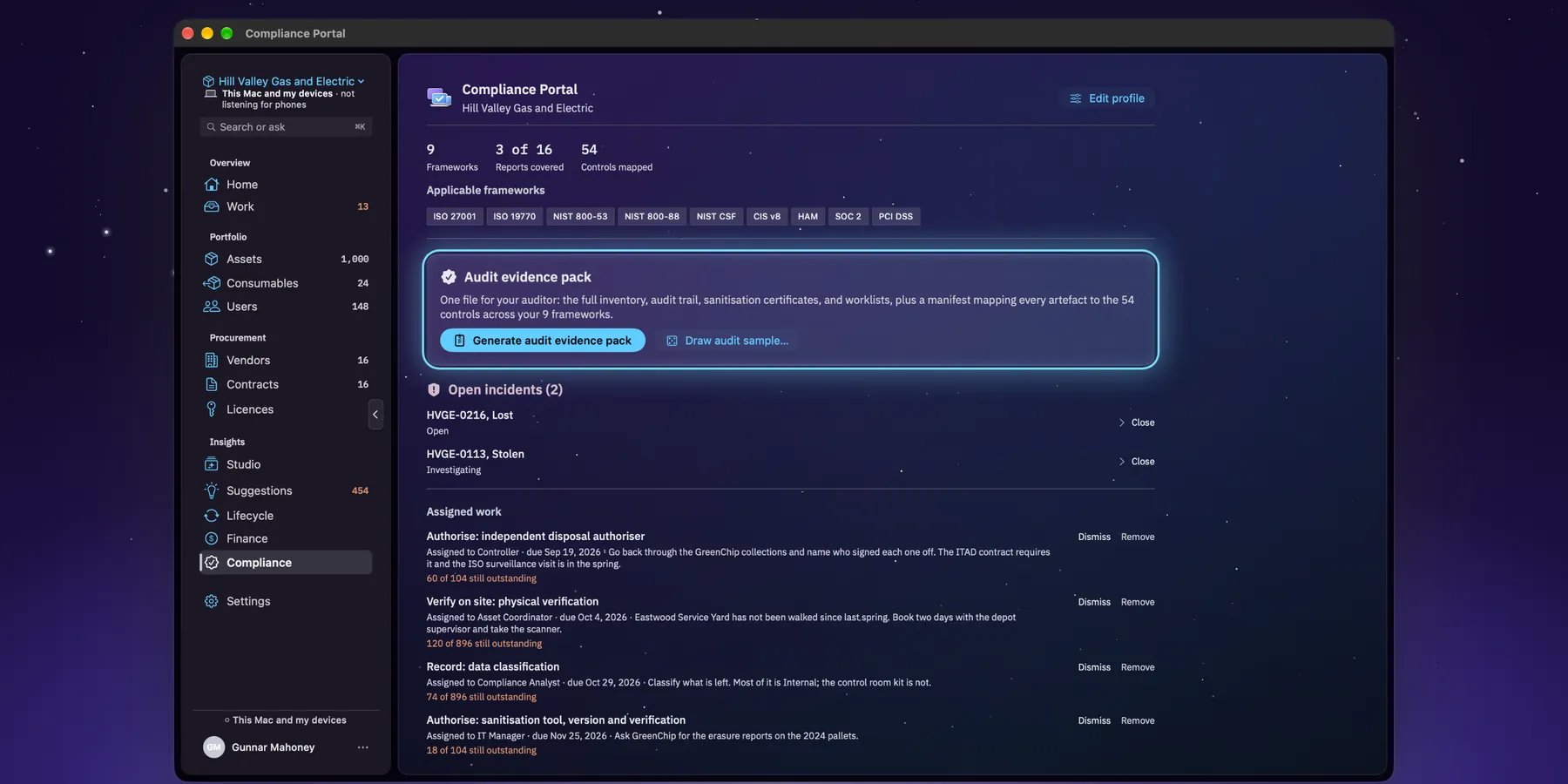
  • 72 controls · 12 standards · 16 evidence reports
  • Free 3-day demo with 1,000 assets
  • Windows version in development
The problem

Cloud asset tools charge per seat, keep your inventory on their servers, and now charge extra to run AI over it.

What we built

A full IT asset register. The iPhone app works on its own, even with no signal at the rack, and the Mac is the full desk with directory sync from Okta or Microsoft Entra. NFC tags open a record with a tap. The assistant answers on-device with Apple Intelligence and calls its own tools, and every answer links back to the assets behind it.

The judgment calls

A local register is a file on your device: no account, no telemetry. On Starkive Cloud, the most sensitive fields are encrypted on the device with a key we never receive. The audit trail can’t be edited from the app. And we kept AI out of the import that writes the register, because an auditor needs the same file to give the same result every time.

Application replacementAI engineeringGovernance
The Starkive Manifest compliance portal
Manifest agent servers Agent platform

Letting outside AI agents into an audited register, safely.

The problem

Teams want to ask an AI agent about their assets. But this register goes to auditors, and every change in it is signed by a real person.

What we built

Two MCP servers. The first reads the register through the same code the app’s own screens use, so an agent and a person always see the same numbers. It opens the database read-only, because an agent has no name to sign a change with. The second runs the support desk, and it’s a separate process on purpose: it holds the cloud key, the register server holds none.

The safeguards

Keys come from the environment, never the command line where other users can see them. The support agent was never given a mail key, so no prompt can talk it into emailing a customer. Every row it returns is stamped with where it came from.

Agent platformsGovernance
Starkive Studio Mac App Store and Microsoft Store

Private AI for the documents you’d never upload.

  • On the Mac App Store since 6 Jul 2026
  • On the Microsoft Store for Windows
  • No account, no sign-in, no subscription
The problem

Getting AI to read a contract usually means uploading the contract to somebody else’s cloud.

What we built

A PDF workspace, file encryption and a password vault in one app. On the Mac it turns scans into searchable text, summarizes and answers questions on the device, and its redaction takes the words out of the file, not just off the screen.

The detail that matters

On Macs without Apple Intelligence, the AI features step aside cleanly and everything else keeps working. Built in five weeks: two to understand the job, three to build it.

How we build Our own practice

We use AI agents to build software every day. With checks.

Review by a second model

A different model reviews every chunk of work and tries to break it before it ships. Then we check its claims instead of trusting them.

Local and frontier, side by side

We run models on our own hardware for private work, share them across the office network, and pay for frontier models only where they earn it.

Our own tooling

MCP servers, private search and voice, and routing that decides which model gets which job. What we teach in workshops is what we use on Monday.

Agent platformsTraining
AI governance

Rules that hold up when the agent is actually running.

Most AI policies are written by people who’ve never wired up an agent. Ours come from building them. These are the rules we follow in our own products, and the ones we’ll help you put in place.

Read-only until proven otherwise

An agent starts by reading. Letting it write is a separate decision, with a design behind it.

Only the keys the job needs

If an agent shouldn’t send email, it doesn’t get an email key. A missing key can’t be talked around.

Every answer shows its source

You can trace a figure back to the record it came from, so a person can check the model.

Keep AI out of the record of truth

Where auditors rely on the result, we use predictable code. AI helps around it, not inside it.

People sign the big stuff

Anything you can’t undo, like sending, paying or deleting, waits for a named person to approve it.

Know the bill before you ship

We model the running cost up front and watch it after launch. No surprise invoices.

The part nobody talks about: tokens aren’t cheap.

Every time an AI tool runs, it costs money. The excitement wears off fast, and the bill doesn’t. We tell you the real running cost before you commit, and we set up monitoring so you see it as it happens, not at the end of the month.

How it works

We start with your business, not the tool.

1

Learn how you work

Where the time goes, where the money goes, and what keeps falling through the cracks.

2

Find the real use cases

The specific jobs where AI, a new app or a better process would actually pay off.

3

Do the math

Build cost and running cost against what you get back. If the numbers don’t work, we say so.

4

Build it with guardrails

Ship it, train your team on it, and keep watching the cost and the risks after launch.

Questions

Straight answers.

Do we have to use Apple gear? +

No. Our products run on Mac, iPhone and Windows, and client work runs wherever your team does: the web, Microsoft 365, Google Workspace, your own servers.

Can you work with the AI tools we already pay for? +

Yes. Copilot, ChatGPT, Claude, Gemini or local models. We’ll help you get more out of what you have before you buy anything new.

Will you ever tell us not to use AI? +

Yes, and often. Sometimes a simple tool or a process change does the job for a fraction of the cost. You’ll get an honest answer either way.

What does it cost? +

Training and governance are quoted per engagement. Builds are scoped after a short call, and we show you the running cost before we start.

Let’s see where AI actually pays off for you.

A free review of what you run and what you spend. Plain answers, no jargon, no pressure.

Book a Free AI Review →